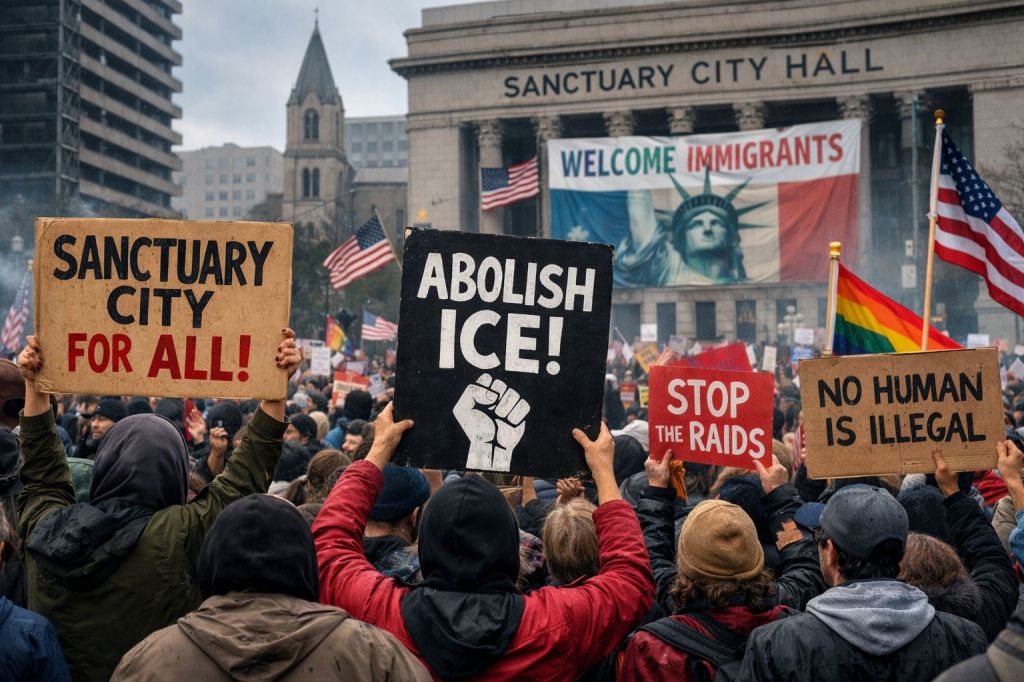
Across the U.S., the latest wave of anti-ICE demonstrations is being driven by a specific flashpoint: a major federal immigration surge centered on the Minneapolis–St. Paul metro—and the way that surge has been publicly justified using Minnesota’s long-running fraud scandals. The result is a combustible mix of real wrongdoing, sweeping rhetoric, aggressive enforcement, and a community backlash that has now gone national. (Reuters)
1) The immediate trigger: an ICE “surge” and deaths that galvanized protest
In late January 2026, protests accelerated after two U.S. citizens were fatally shot during ICE activity in Minneapolis, according to reporting from Reuters and other outlets—events that organizers have pointed to as evidence that federal tactics have escalated beyond ordinary enforcement. (Reuters)
Those shootings became the emotional center of a national protest call—walkouts, rallies, and “ICE Out” actions in dozens of states—framed as a response to “Operation Metro Surge” (the name used in multiple reports for the Minneapolis-focused enforcement operation). (Reuters)
2) Why Minneapolis? The government’s argument ties immigration enforcement to fraud
Federal officials and the Trump administration have repeatedly connected the Minneapolis deployment to fraud investigations—arguing that a large federal footprint is necessary not only for immigration enforcement but also to pursue alleged fraud in federally funded programs. CBS News reported that the surge included large numbers of Homeland Security Investigations personnel (HSI) expected to probe fraud cases while ICE enforcement operations expanded in immigrant-populated neighborhoods. (CBS News)
That fraud backdrop is not invented out of thin air. Minnesota has seen a string of large alleged schemes and prosecutions spanning federal programs—nutrition assistance, housing stabilization, and child care subsidies—with dozens of indictments and convictions reported since 2021. (CBS News)
The administration has leaned into that narrative publicly, portraying Minnesota as a “fraud epidemic” and highlighting measures such as “door-to-door investigations” and arrests of people it describes as “criminal illegal aliens.” (The White House)
3) The contested leap: “fraud” becomes shorthand for “illegal immigrants”
Here’s where the protests and the fraud story collide.
Fraud cases are about conduct (billing schemes, false claims, misuse of funds). Immigration enforcement is about status and removability under immigration law. The government has fused these themes rhetorically—often implying that the fraud problem is inseparable from “illegal immigration”—and critics argue that this framing invites a kind of collective suspicion aimed at entire communities rather than specific defendants. (CBS News)
That dynamic is especially visible in the way Somali communities in Minnesota have been discussed. An Associated Press report describes how viral content alleging widespread fraud at Somali-run child care centers spread well beyond Minnesota—despite inspectors disputing central claims in at least one high-profile video—leading to harassment and intimidation of providers. (AP News)
So, even while prosecutors pursue specific alleged schemes, the public narrative can widen into something else: “fraud” as a generalized accusation attached to an ethnicity or immigrant identity—an effect that protest organizers say is inseparable from the surge itself. (AP News)
4) How the surge itself feeds the protest message
Anti-ICE protest movements often grow fastest when enforcement looks indiscriminate or militarized—and Minneapolis has offered plenty of images and allegations that supporters cite as proof of overreach: heavily armed agents, stops in public places, and detentions that appear (to critics) driven by race or accent rather than individualized probable cause. (Reuters)
In a lawsuit filed by Minnesota (and Minneapolis/St. Paul), the state argues the operation has involved “militarized raids” and unconstitutional tactics, and that the “fraud” rationale is being used as a pretext for a much broader federal crackdown.
A federal judge recently denied Minnesota’s request to halt the operation—meaning the legal fight continues, but the surge remains in effect for now. (The Guardian)
From the protest movement’s perspective, that court denial doesn’t settle the moral question—it intensifies it. Demonstrations aren’t only about immigration policy in the abstract; they’re about what protesters see as an enforcement model that is punishing communities while invoking fraud as the justification. (Reuters)
5) The feedback loop: enforcement → fear → confrontation → broader crackdowns
Once a city becomes a national symbol, actions on both sides can spiral.
- Federal stance: The administration points to fraud investigations and public safety, touts arrests, and treats Minneapolis as a proof-of-concept for tougher immigration enforcement. (The White House)
- Local and activist stance: Organizers argue the surge is built on profiling, intimidation, and collective blame—especially when high-profile misinformation (like viral daycare “fraud” claims) catches fire and targets real people. (AP News)
- Public reaction: As clashes and tragedies occur, national groups replicate the protests elsewhere—turning what might have stayed local into a coordinated, nationwide campaign. (Reuters)
That loop is why Minneapolis’ fraud scandals—some of them years in the making—are suddenly central to street protests happening right now. Minneapolis isn’t just “where fraud happened” or “where ICE is active.” It’s where the two storylines have been intentionally braided together in public messaging, and where the consequences have been most visible. (CBS News)
6) What’s easy to miss: two things can be true at once
A clear-eyed view requires holding two realities simultaneously:
- Minnesota has faced serious alleged fraud schemes, with real prosecutions and convictions reported—meaning oversight and accountability are legitimate public concerns. (CBS News)
- Using “fraud” as a broad political cudgel can distort enforcement, especially when it becomes a proxy accusation aimed at “illegal immigrants” or specific ethnic communities, or when viral misinformation is treated as proof. (AP News)
That tension—between targeted accountability and sweeping suspicion—is the connective tissue between the Minneapolis fraud story and the anti-ICE protests.
 The Eden Protocol
Leave a comment