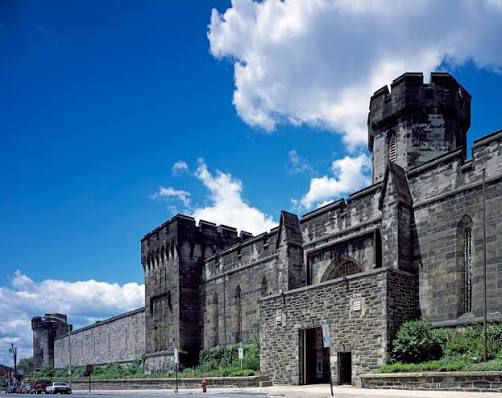
A Fortress of Stone, Silence, and Spirits
Rising like a crumbling medieval castle in the heart of Philadelphia, Eastern State Penitentiary is more than a historic prison—it’s one of the most infamous haunted locations in the United States. With its decaying cellblocks, looming guard towers, and long corridors of shadow, the penitentiary has become a focal point for paranormal lore, ghostly encounters, and psychological unease that lingers long after the gates closed.
A Radical Experiment in Isolation
Opened in 1829, Eastern State Penitentiary was revolutionary—and terrifying—for its time. Built on the “Pennsylvania System,” inmates were kept in total solitary confinement, sometimes for years. Prisoners were hooded when moved, forbidden to speak, and left alone with only a Bible and their thoughts. The intent was moral reform through reflection. The result, according to historical records, was often mental collapse.
Charles Dickens visited in 1842 and condemned the practice, writing that the system inflicted “immeasurable torture and agony.” Many prisoners suffered hallucinations, paranoia, and insanity—conditions that modern psychologists now associate with prolonged isolation.
That psychological suffering is central to why many believe Eastern State is haunted.
Cells That Refuse to Stay Silent
Visitors and investigators consistently report strange phenomena throughout the prison, especially in Cellblocks 4, 6, 8, and 12:
- Disembodied whispers echoing through empty corridors
- Footsteps where no one is present
- Shadow figures darting across cells or standing at the ends of hallways
- Sudden cold spots, even during summer months
- Laughter and crying heard late at night
Cellblock 12 is particularly notorious for reports of a dark, human-shaped shadow that appears and vanishes without sound. Cellblock 4 has been associated with faces appearing in cell walls and voices calling out to visitors by name.
Former guards and staff have gone on record describing feelings of dread, panic, or being watched—sometimes refusing to work certain areas alone.
The Infamous Al Capone Cell
One of the most famous inmates was Al Capone, who served time at Eastern State in 1929. Unlike the grim conditions most prisoners endured, Capone’s cell was lavishly furnished with rugs, fine furniture, artwork, and even a radio.
Despite the comfort, Capone reportedly suffered from paranoia and insomnia while imprisoned there. Some visitors claim to feel a heavy presence in or near the cell—less violent, more oppressive—suggesting that wealth and power offered no real escape from the prison’s psychological grip.
Residual Hauntings or Something More?
Paranormal investigators often debate whether Eastern State is home to residual hauntings—emotional echoes replaying traumatic moments—or intelligent entities capable of interaction. EVPs (electronic voice phenomena), unexplained light anomalies, and motion-triggered events have been documented during investigations.
Skeptics argue that the power of suggestion, combined with the prison’s dark history and unsettling architecture, can explain many experiences. Believers counter that the consistency of reports across decades—and from people unaware of the legends—points to something deeper.
What’s undeniable is the atmosphere. Eastern State feels charged. The silence is heavy. The walls seem to absorb sound—and perhaps memory.
A Living Ruin
Eastern State Penitentiary closed in 1971 and now stands as a preserved ruin, offering daytime tours focused on criminal justice reform and nighttime events that lean into its haunted reputation. Whether approached as history, psychology, or paranormal mystery, the site leaves a profound impression.
Some visitors leave thrilled. Others leave shaken. A few claim they don’t leave entirely alone.
Eastern State Penitentiary remains a monument to human suffering, flawed ideals, and unanswered questions—where the line between past and present feels dangerously thin.
 The Eden Protocol
Leave a comment