Category: Unsolved

Unsolved Mysteries

  • The Murder of Carina Saunders

    “Dismemberment in Bethany”: A deep-dive into the 2011 murder of Carina Saunders

    Snapshot

    Victim: Carina Brianne Saunders, 19

    Where her remains were found: In a bag behind a grocery store near NW 23rd & Rockwell, Bethany, Oklahoma

    Discovery date: October 13, 2011

    Status (as of November 2025): Unsolved; OSBI (Oklahoma State Bureau of Investigation) is the lead agency and continues to seek tips.

    Who was Carina Saunders?

    Public reporting focuses less on biography than on the brutality and controversy surrounding the case. Family members last saw Carina in late September 2011. Surveillance later placed her at the Newcastle Casino on October 8, 2011, where she got into a red Ford four-door pickup—considered her last verified sighting.

    Timeline: the crucial week

    Sept. 28, 2011 (approx.) – Family last saw Carina.

    Oct. 8, 2011 – Casino security captured Carina getting into a red, dual-cab Ford pickup; one man seen exiting the truck had tattoo sleeves on both arms, details investigators publicized later in appeals for information.

    Oct. 11, 2011 – A later federal court filing summarizes that investigators believe the murder occurred this day; it also records that Luis Ruiz (later a dismissed suspect) was arrested that same day on an unrelated warrant by Oklahoma City Police.

    Oct. 13, 2011 – Bethany police, responding to a foul odor behind a store at 7101 NW 23rd St., found a black nylon bag containing a severed head and dismembered body parts; the remains were identified as Carina’s.

    The OSBI’s cold-case listing corroborates the casino sighting and the location of the discovery, and notes that reports surfaced about a video depicting the murder—an allegation that became central and later deeply contested.

    The first investigation (2011–2013): arrests, a “murder video,” and collapsed charges

    Under intense public pressure, Bethany Police advanced a theory that traffickers had abducted Carina and recorded her killing. In July 2012, two men—Jimmy Massey and Luis Ruiz—were arrested and charged with first-degree murder. The allegations leaned heavily on witness accounts referencing a cell-phone “snuff” video, which authorities never produced publicly.

    By February 25, 2013, the Oklahoma County DA dismissed the charges against both men, explicitly leaving the door open to refile. Local outlets reported that a key witness recanted, and the case file as built by Bethany Police was deemed too weak to proceed.

    The Courthouse News account of Ruiz v. City of Bethany provides further context from civil filings: attorneys alleged investigators used “deceptive, misleading, manipulative and illegal tactics,” contributing to the collapse. (Those are allegations from the lawsuit, not findings of criminal wrongdoing.)

    After the dismissal, Massey later pled guilty to unrelated drug felonies and received a prison term; those convictions were not for Carina’s murder.

    Reset (2013–present): OSBI takes over; tips, digs, and continuing appeals

    Following the botched prosecution, the OSBI became the lead agency and has repeatedly asked the public for help. Their official cold-case page summarizes the known facts and reiterates the casino sighting and alleged video.

    Investigators and media continued to surface leads. For example, in April 2017 a former residence linked to a person of interest was excavated; nothing publicly announced from that effort led to charges.

    On case anniversaries, OSBI and local media renew appeals, emphasizing possible human-trafficking connections and the still-critical identification of the red Ford pickup and the tattoo-sleeved man seen at the casino. Coverage in 2016 and again in 2025 reflects that focus, and confirms the case remains open.

    Civil fallout and scrutiny of the original casework

    Beyond the criminal case, civil litigation scrutinized the earliest investigation. In 2014, Ruiz filed a federal civil-rights lawsuit against the City of Bethany and specific officers; court records captured uncontested baseline facts about discovery and timing and allowed some claims to proceed past a motion to dismiss. Subsequent reporting shows the city settled with Ruiz in 2016 (settlement terms were not fully detailed in The Oklahoman’s public piece).

    Local reporting and filings depicted a department under strain, with later personnel turbulence and evidentiary management questions, though not all allegations resulted in sustained discipline. This history helps explain why the DA and OSBI re-centered the investigation away from the 2012 theory. (Again, many of these points appear in filings and reporting, not as adjudicated misconduct findings.)

    What is actually known—and what isn’t

    Known

    Carina was alive into Oct. 8, 2011; last verified on casino video getting into a red Ford four-door/dual-cab pickup.

    Her dismembered remains were found Oct. 13, 2011 behind a Bethany grocery store; the death was ruled a homicide.

    Prosecutors dropped the 2012 murder charges against Massey and Ruiz in 2013 due to evidentiary problems; the case remains unsolved.

    Unproven/contested

    The existence and content of a “murder video.” OSBI has said reports of such a video surfaced, and they have publicly sought it, but no video has been produced to the public and it was not introduced as evidence in a successful prosecution.

    Specific human-trafficking conspirators or a definitive crime scene: While investigators and reporters have referenced trafficking angles and a possible abandoned house, those details have not led to charges that held.

    Why the early case collapsed: investigative and evidentiary pitfalls

    1. Overreliance on shaky testimony – Key witness accounts later changed or recanted, undermining probable cause. Prosecutors then dismissed charges “pending further investigation.”

    2. Failure to corroborate marquee evidence – The alleged snuff video became a centerpiece without public corroboration; such an anchor, if unverified, can distort an investigation. OSBI has continued to ask the public for any copy.

    3. Institutional credibility issues – Allegations in civil filings and subsequent reporting painted a picture of a pressured, error-prone early investigation, which complicated later prosecution efforts. (These are allegations from lawsuits and media, not criminal findings.)

    The human cost

    Family members, including Carina’s sister Sarah Saunders, have stayed publicly engaged, advocating for accountability and—more recently—sharing lessons with trainees to improve future casework. Their comments also illustrate frustration with resources and staffing that cold-case investigators face.

    Where the case stands today (2025)

    The OSBI Cold Case Unit lists Carina’s homicide as active and unsolved. In October 2025, local outlets again marked the 14-year anniversary, underscoring the same key lead points (casino sighting; red Ford pickup; tattoo-sleeved man) and noting investigators still believe there may be trafficking ties.

    Takeaways and investigative avenues that still matter

    The truck & the tattooed man: Re-publicizing the vehicle description and distinctive tattoos could surface new witnesses—tattoos age, but many are recognizable across years.

    Digital drift: If a video ever existed, copies may persist on old phones, SD cards, or cloud backups; targeted digital forensics and public amnesty campaigns sometimes flush out artifacts years later. (OSBI has explicitly asked for the video.)

    Contextual victims/witnesses: Reported trafficking contexts can deter witnesses. Trauma-informed outreach and immunity/leniency frameworks can be decisive in unlocking testimony. (This reflects best practices; the trafficking angle is in media/OSBI appeals, not in a filed, sustained charge.)

    If you know something

    OSBI asks anyone with information to contact the Cold Case Unit (email on their site) or call their tip line; tips can be anonymous.

    Sources

    OSBI cold-case listing and appeals (timeline, casino sighting, request for video; current status).

    The Oklahoman reporting on charge dismissal (2013), anniversary appeals (2016), and civil settlement (2016).

    KOCO/OKC local TV coverage on dismissal, later appeals, and 2025 anniversary context.

    CBS News summary of OSBI’s 2016 public information (tattoo-sleeved man; casino sighting; homicide determination).

    Court records in Ruiz v. City of Bethany (factual timeline; motion-to-dismiss order).

    Courthouse News overview of the civil allegations (investigative-tactics claims).

  • HALLOWEEN HORRORS

    Here’s a sober deep-dive on Halloween’s darkest real-world crimes—focusing on what happened, why these cases seared themselves into public memory, and what patterns and myths they’ve fueled. I’ll avoid gory detail while keeping the historical record clear and well-sourced.

    Why Halloween crimes loom so large

    Halloween blends anonymity (costumes, masks), routine door-to-door contact, and late-night parties—ingredients that make certain offenses easier to attempt and harder to attribute. Even so, the holiday’s reputation is shaped more by a few infamous cases and persistent myths than by any proven, annual crime wave.

    The benchmark case: the “Candy Man” poisoning (Texas, 1974)

    No Halloween crime has reverberated like Ronald Clark O’Bryan’s murder of his eight-year-old son with cyanide-laced Pixy Stix to collect life-insurance money. The crime—committed during trick-or-treating in Deer Park, Texas—cemented decades of parental fear about tainted candy, despite its rarity. O’Bryan was convicted and executed in 1984. Contemporary court records and retrospectives confirm the plot, the motive, and the enduring cultural impact.

    A home-invasion double murder in “wine country” (Napa, 2004)

    Just after Halloween night in Napa, California, roommates Leslie Mazzara and Adriane Insogna were stabbed to death in their home while a third roommate escaped and called 911. The case rattled a community not known for violent crime. Eleven months later, Eric Matthew Copple—who knew one victim through his future wife—turned himself in and later pleaded guilty to two counts of first-degree murder; he received life without parole. Local reporting and national coverage detail the break in the case (including cigarette-butt DNA), the plea, and sentencing.

    The Liske family murders (Ohio, 2010)

    On Halloween morning in 2010 near Toledo, William “BJ” Liske killed his father, stepmother, and stepbrother at their homes—an intrafamilial massacre that shook the region. Coverage from the local Sandusky Register reconstructed the timeline; the case appears routinely in Halloween-crime roundups because of its date and brutality.

    The “Trick-or-Treat” doorstep killing (Los Angeles, 1957)

    Beauty-salon owner Peter Fabiano was shot dead at his front door late on Halloween by a costumed assailant who blended in with trick-or-treaters. Investigators ultimately tied the plot to Joan Rabel and Goldyne Pizer; both pleaded guilty to second-degree murder. The case endures as an archetype of a killer using Halloween’s disguises to get close to a victim.

    A serial-killer outlier on Halloween night (Los Angeles, 1979)

    The “Toolbox Killers” (Lawrence Bittaker and Roy Norris) abducted 16-year-old Shirley Ledford after a Halloween party on Oct. 31, 1979—their final known murder in a months-long spree. Official records and court opinions establish the date and the sequence of events; the case is often cited to show how the holiday’s late-night mobility can intersect with predatory offenders. (Note: accounts include disturbing details; the citation here sticks to legal records.)

    An unsolved Chelsea double murder (New York City, 1981)

    Photographer Ronald Sisman, 39, and student Elizabeth Platzman, 20, were found beaten and shot in Sisman’s apartment on Halloween night. The ransacked scene fueled persistent (but unproven) theories—including rumored links to David Berkowitz (“Son of Sam”). The case remains officially unsolved, periodically revisited in true-crime media.

    A Halloween-party disappearance turned homicide (Tennessee, 2011)

    Karen Swift vanished after a Halloween party; six weeks later, her body was found, and the case dragged on for years. Her estranged husband was charged in 2022; in 2024 he was acquitted on murder but faced a mistrial on a lesser charge, with proceedings continuing into 2025. The timeline highlights how Halloween social dynamics can complicate early investigations.

    Patterns, myths, and takeaways

    1) The poisoned-candy myth vs. reality.
    The O’Bryan case is the outlier that proved the fear possible—but not common. Public-health reviews and journalism over decades have found virtually no verified cases of a stranger poisoning random Halloween candy; the 1974 murder was a targeted filicide disguised as a random threat. Nonetheless, it permanently changed parental behavior (e.g., candy checks, supervised routes).

    2) Halloween’s anonymity matters—but so do relationships.
    Several headline cases involved offenders who knew the victims (Napa 2004; O’Bryan 1974), undermining the idea that Halloween dangers are chiefly from anonymous strangers.

    3) Late-night mobility and parties increase exposure.
    Ledford’s abduction after a party and numerous post-party incidents underscore risk factors that aren’t unique to Halloween but can peak then: nighttime travel, intoxication, and crowded social calendars.

    4) Media amplification turns rare events into cultural archetypes.
    The Fabiano “trick-or-treat slaying” and the “Candy Man” poisoning became templates in popular imagination—stories retold each October and often generalized into broad safety warnings.

    Practical safety notes (without sensationalism)

    Supervise young trick-or-treaters; stick to known neighborhoods and check that commercially sealed candy is intact. (The iconic case involved tampering by a parent, not strangers—but basic vigilance still helps.)

    For teens and adults, plan transport before parties; travel in groups; share live locations; and use verified rides. (Late-night returns were factors in multiple cases above.)

    At home, good lighting, cameras/doorbell video, and answering the door while keeping distance help when you can’t see faces clearly—especially late after the main rush. (Fabiano’s case is a historical outlier, but the tactic—mask plus doorstep approach—is a known risk.)

    Bottom line

    Halloween does not inherently “cause” violent crime—but its masks, motion, and myths create conditions that certain offenders have exploited. A handful of notorious cases—the O’Bryan poisoning in 1974, the Napa killings in 2004, the Liske murders in 2010, the Fabiano doorstep slaying in 1957, the Ledford abduction in 1979, and the Sisman/Platzman double murder in 1981—explain why the holiday’s funhouse mirror also reflects some of true crime’s most enduring nightmares.

  • The Abduction of Amber Hagerman

    UNSOLVED

    Arlington Police

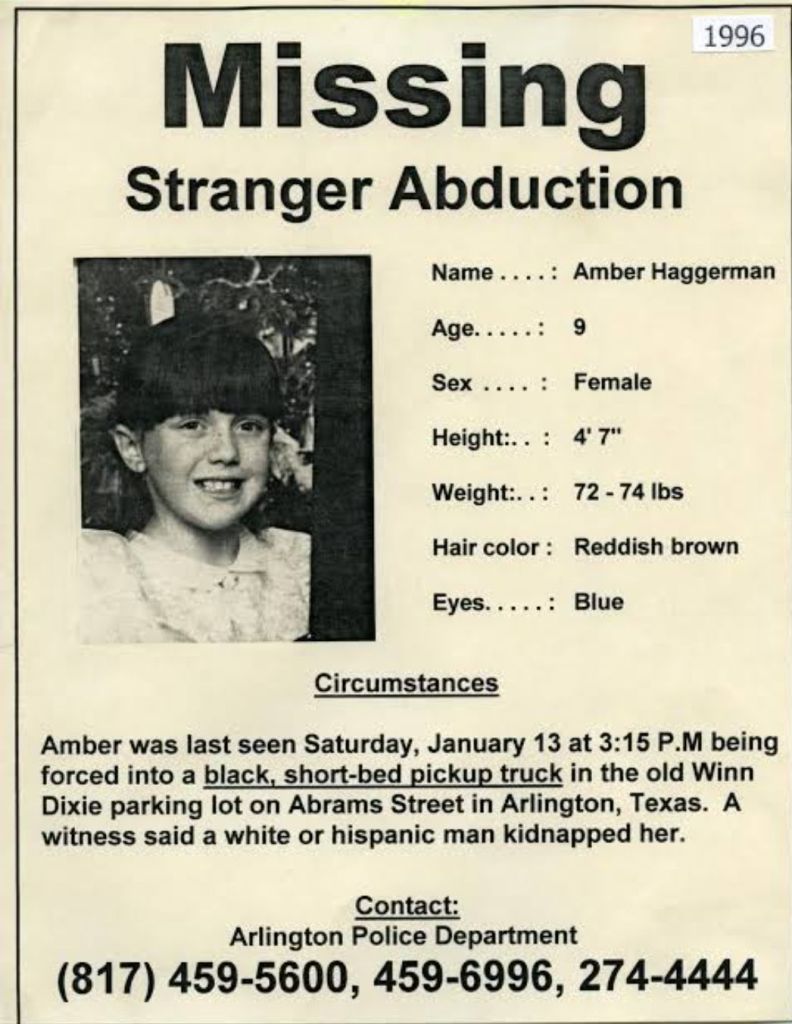
    ARLINGTON GIRL REMEMBERED: THE ABDUCTION AND LEGACY OF AMBER HAGERMAN

    January 13, 1996 — Arlington, Texas

    In the quiet suburb of Arlington, Texas, an ordinary Saturday afternoon turned into a national tragedy when 9-year-old Amber Hagerman was abducted in broad daylight. Riding her pink bicycle near the Winn-Dixie parking lot just a few blocks from her grandparents’ home, Amber’s joy was shattered when a black pickup truck pulled up and a man forcibly took her.

    A witness, a retired machinist, immediately called 911 after seeing the horrifying scene unfold. But despite a rapid police response and a community search effort that stretched across the Dallas–Fort Worth area, Amber’s body was found four days later in a creek bed. She had been brutally murdered. Her killer has never been identified.

    Amber was described by her family as adventurous, kind-hearted, and full of dreams. She loved riding her bike and hoped to become a teacher. The shock of her death resonated far beyond Texas, capturing national attention and prompting widespread outrage. But from that grief emerged something powerful: the AMBER Alert system.

    From Tragedy to National Safety Net

    Named in Amber’s honor—though the acronym now officially stands for America’s Missing: Broadcast Emergency Response—the AMBER Alert was born from the determination of her family, local broadcasters, and law enforcement to prevent such tragedies from happening again. Just months after Amber’s death, Dallas-Fort Worth broadcasters teamed up with law enforcement to develop the first alert system.

    It quickly spread across states and, by 2003, became a federally coordinated program. Today, AMBER Alerts are sent instantly through cell phones, radio, television, and highway signs when a child is abducted and believed to be in danger.

    As of this writing, more than 1,100 children have been recovered thanks to the system bearing Amber’s name.

    An Unfinished Story

    Though Amber’s name lives on through a system that saves lives, her own case remains unsolved nearly three decades later. Arlington police continue to pursue leads. “We will never stop looking for justice for Amber,” a detective from the Arlington Police Department said at a memorial held earlier this year.

    Her mother, Donna Williams, still hopes for closure. “Someone knows something,” she said in an emotional public appeal. “Please, if you remember anything, come forward.”

    Amber Hagerman’s story is one of deep sorrow but also of lasting legacy. Her life may have been short, but her memory continues to protect the lives of countless others.

    If you have any information about the abduction or murder of Amber Hagerman, please contact Arlington Police Department or Crime Stoppers. You can remain anonymous.

  • The Yogurt Shop Murders

    UNSOLVED

    The Chilling Mystery of the Yogurt Shop Murders in Austin

    AP

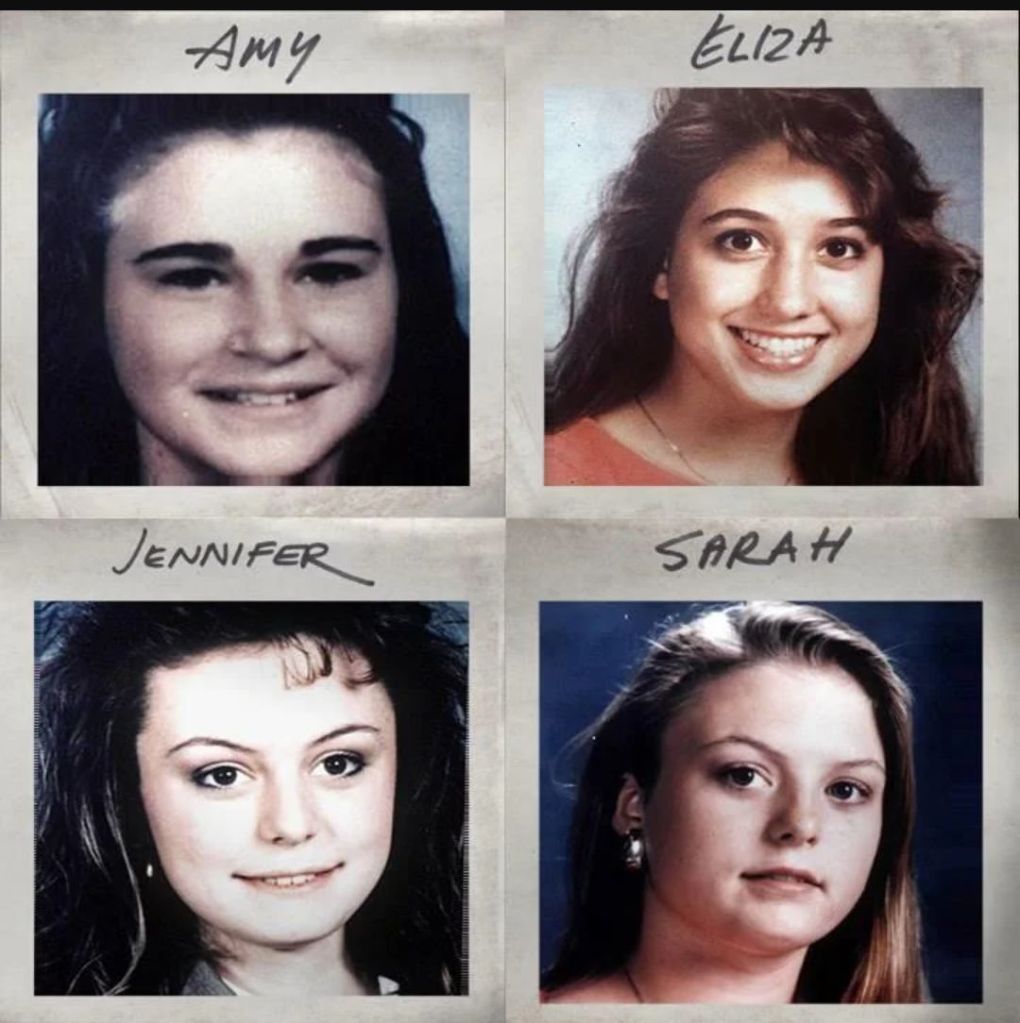
    On December 6, 1991, Austin, Texas was rocked by a horrific crime that remains one of the most haunting unsolved cases in American history. Known as the “Yogurt Shop Murders,” the brutal slaying of four teenage girls inside a frozen yogurt store shocked the community and captivated the nation for decades.

    The Crime

    The victims—13-year-old Amy Ayers, 17-year-old Jennifer Harbison, her 15-year-old sister Sarah Harbison, and 17-year-old Eliza Thomas—were found bound, gagged, and shot execution-style in the back of the “I Can’t Believe It’s Yogurt!” store where Jennifer and Eliza worked. The shop had been set on fire in an apparent attempt to destroy evidence. Only Amy Ayers initially survived the gunshot wounds, but a second shot to the head ended her life as well.

    The sheer brutality of the murders—combined with the fact that the victims were so young and innocent—made the crime scene almost incomprehensible. It was clear that the attack was cold-blooded, but the motives and identities of the perpetrators remained a mystery.

    A Flawed Investigation

    The Austin Police Department was immediately under intense pressure to solve the case. In the years following the murders, the investigation was marred by controversy, false leads, and questionable confessions.

    In 1999, eight years after the murders, four men—Maurice Pierce, Forrest Welborn, Michael Scott, and Robert Springsteen—were arrested. The case largely hinged on confessions obtained during intense, hours-long interrogations, where no lawyers were present. Springsteen and Scott were convicted in 2001 and 2002, respectively, but the convictions began to unravel due to concerns about the validity of their confessions and the lack of physical evidence.

    In 2009, DNA testing revealed that DNA found at the crime scene did not match any of the four men accused. As a result, the charges were dropped, and the case officially went cold once more.

    Lingering Questions and Theories

    More than 30 years later, the Yogurt Shop Murders remain unsolved. Advances in forensic technology continue to offer hope that one day, the killer—or killers—might be identified. There are still many questions: Was it a robbery gone wrong? A premeditated act? Were the victims targeted for a reason, or were they simply in the wrong place at the wrong time?

    The lack of resolution has left a painful legacy for the families, the community, and the city of Austin. Every so often, the case is re-examined by cold case units and armchair sleuths alike, hoping to find the missing puzzle piece that can bring justice.

    Why It Still Haunts Us

    The Yogurt Shop Murders represent more than just an unsolved case—they symbolize the vulnerability of youth, the fallibility of the justice system, and the enduring pain of unanswered questions. It’s a story of innocence lost, and a chilling reminder that even in a seemingly quiet community, darkness can strike without warning.

    As technology advances and investigative techniques evolve, there remains hope that one day, the truth will come to light. Until then, the memory of Amy, Jennifer, Sarah, and Eliza continues to echo through the halls of justice, waiting for their story to be resolved.