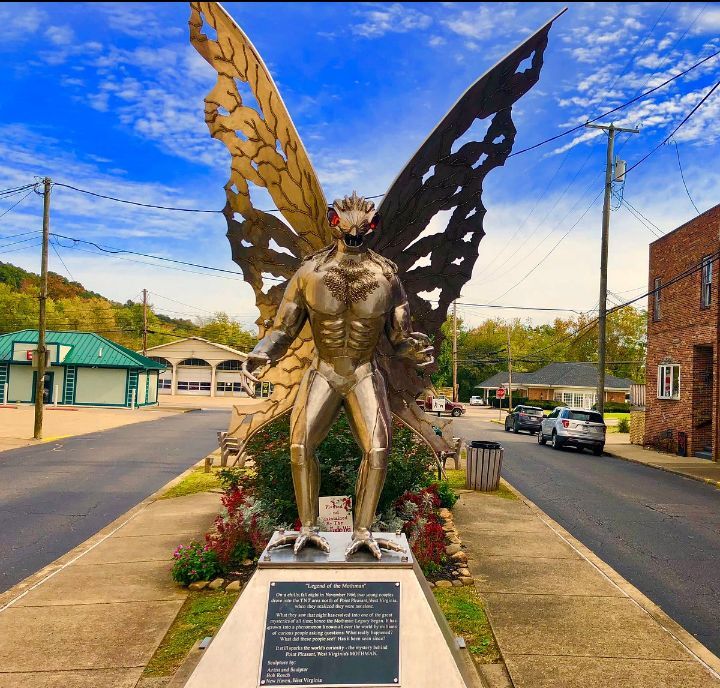
The Mothman Incident: West Virginia’s Winged Omen
Point Pleasant & the Birth of a Legend (1966–1967)
In the quiet Ohio River town of Point Pleasant, West Virginia, a series of strange encounters between November 1966 and December 1967 would give birth to one of America’s most enduring paranormal legends: the Mothman.
What began as a handful of frightened eyewitness reports quickly spiraled into national headlines, UFO sightings, Men in Black rumors, and ultimately, tragedy.
The First Sighting: November 15, 1966
The modern legend began when two young couples—Roger and Linda Scarberry, and Steve and Mary Mallette—told police they had encountered a large, winged creature near an abandoned munitions facility known locally as the “TNT Area.”
They described:
A man-sized figure
Large wings folded behind its back
Glowing red eyes
The ability to rise straight into the air
Incredible speed—reportedly keeping up with their car at nearly 100 mph
Local newspapers, including the Point Pleasant Register, picked up the story. The term “Mothman” was reportedly inspired by the popularity of the Batman TV series at the time.
The TNT Area: Ground Zero
The TNT Area was a former World War II explosives site filled with concrete igloos, wooded terrain, and abandoned structures—an ideal breeding ground for rumor and fear.
Soon after the initial sighting:
More residents reported seeing a red-eyed creature.
Livestock behaved strangely.
UFO sightings increased.
Reports of mysterious “Men in Black” visiting witnesses began circulating.
Whether these events were connected—or products of collective anxiety—remains debated.
The Year of High Strangeness
Between late 1966 and 1967, Point Pleasant became a hotspot for:
UFO reports
Poltergeist claims
Phone interference
Strange lights over the Ohio River
Some researchers later suggested the region was experiencing a classic “flap”—a wave of paranormal reports clustered in time and place.
One of the key investigators was author John Keel, who documented the events in his 1975 book The Mothman Prophecies. Keel believed the creature might be an interdimensional entity or harbinger of disaster.
The Tragedy: Silver Bridge Collapse
On December 15, 1967, tragedy struck.
The Silver Bridge—connecting Point Pleasant, West Virginia to Gallipolis, Ohio—collapsed during rush hour traffic.
46 people died
The cause was later determined to be a structural failure: a fractured eyebar in the suspension chain
After the collapse, Mothman sightings abruptly stopped.
For many locals, the connection seemed undeniable: Was the creature a warning? An omen? Or simply coincidence layered onto trauma?
Explanations: Skepticism vs. Supernatural
黎 The Sandhill Crane Theory
Skeptics argue witnesses likely saw a sandhill crane, a large bird with:
Red markings around the eyes
A wingspan up to 7 feet
Rare but possible migration into the area
However, critics of this explanation note:
Cranes do not typically match the described body proportions.
They do not chase cars at high speeds.
️ Psychological & Sociological Factors
Others suggest:
Cold War anxiety
Industrial decay
Local folklore
Mass suggestion
Point Pleasant in the 1960s was a small river town experiencing economic strain. Fear spreads quickly in tight-knit communities.
Paranormal Interpretations
Believers propose:
A cryptid species
An extraterrestrial scout
An interdimensional being
A prophetic entity linked to disaster
The sudden stop in sightings after the bridge collapse remains central to the mystery.
Cultural Legacy
In 2002, the legend reached mainstream audiences with the film:
The Mothman Prophecies starring Richard Gere
Today, Point Pleasant embraces its strange history:
Annual Mothman Festival
What began as fear has become identity—and tourism.
Why the Mothman Endures
The Mothman legend survives because it exists at the intersection of:
Small-town Americana
Cold War paranoia
Grief and tragedy
Archetypal myth
Across cultures, winged watchers and omens appear before disaster. Whether one sees the Mothman as monster, metaphor, or misunderstood bird, it speaks to something deeply human:
Our need to find meaning in chaos.
Final Reflection
Was the Mothman:
A cryptid?
A collective hallucination?
A misidentified crane?
A symbolic warning?
Or a myth born from tragedy?
The bridge fell. The sightings stopped. The story remained.
And in the fog rising off the Ohio River, the legend still takes flight.



 The Eden Protocol